

Completions look great, until real work starts; build gamified learning that changes decisions, not just dashboards.
Why Traditional eLearning Stops Short
Most digital modules are built for navigation, not behavior. They rely on:
- Content density instead of decision practice
- Knowledge checks that confirm memory, not judgement
- Interactions that look engaging, but don’t demand thinking
- “One-size” formats that ignore what the outcome actually requires
The result is predictable. Learners finish. Leaders get completion reports. And the organization still has to push, remind, reinforce – manually.
Because the module didn’t change what people do when it counts.


What Needs to Change
If learning is expected to shift performance, it needs three things most modules never lock:
- A behavioural outcome (not just a topic)
- A medium that can actually build that outcome
- Governance that keeps the module credible at scale
Digital learning works when it stops acting like content and starts acting like a designed experience – where learners must:
-
- interpret
- choose
- feel consequence
- adjust
- improve
That is the gap Gamified eLearning is meant to fill – when built with discipline, not decoration.
Gamified eLearning Solutions by TGC
TGC’s Gamified eLearning is custom module development, delivered end-to-end – from learning intent and experience design to build, QA, and deployment support.
But the defining difference is upstream.
We don’t treat gamification as a layer. We treat it as experience design – governed by behavioral science, adult learning principles, and the neuroscience of play.
So the module doesn’t just look interactive. It behaves differently.
Learners don’t just click. They think, decide, and progress – through structured interaction that builds capability the way work demands it.

The Design System Behind Every Module
Every Gamified eLearning module is created through TGC Gateway™ – a content creation and governance system that locks behavioral integrity before build begins.
1) DCD™ - Design Control Discipline
Before a single screen is built, we lock:
- Be–Do–Have outcomes (belief shift – observable behavior – resulting impact)
- The learning stage (Build Awareness / Deepen Understanding / Embed Sustainable Behaviors)
- Experience level (A–E) based on outcome need
- Claim boundaries (what the module can responsibly say it achieves)
If the “Do” is unclear or not assessable through the experience, the module doesn’t proceed.
2) CDA™ - Content Development Architecture
Once intent is locked, CDA governs how the module is constructed:
- Content containers and progression logic
- Decision and practice design
- Assessment structure (what is measured, and why)
- Writing discipline and interaction rules
- Review gates to prevent late-stage rework
3) GEXOS™ - Gamified Experience Operating System
GEXOS controls the experience layer – responsibly:
- Interaction intensity and feedback boundaries
- Theme and mechanic discipline (what belongs, what doesn’t)
- Motivation design that supports capability, not noise
Gamification mechanics are used only when they strengthen learning. If a mechanic doesn’t teach, it doesn’t stay.
Level A–E and Delivery Readiness
The same discipline applies across the Level A–E range – only the medium and intensity change:
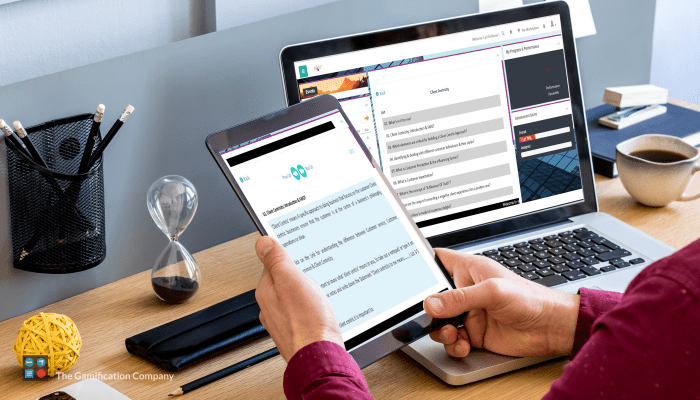
- Level A – structured digital modules with purposeful interaction
- Level B – interactive exploration and guided discovery
- Level C – scenario-based, decision-led learning
- Level D – simulation-style digital practice modules
- Level E – immersive-ready content for MR / VR environments
Delivery is downstream. The content is built to hold regardless of where it’s deployed.
Business to Employee
- Training content distributed digitally via the platform
- Train the trainer modules
- Compliance training
- Skills & Behaviours Training– Complete customer & employee lifecycle
- Psychometric Assessments
- Pre & Post program Assessment
- Product & Process Training
- Product Trouble-Shooters
- Advertise & push different programs via the mobile app platform
- Registration & scheduling of programs directly on the app platform
- IJP Communication & Assessment Centre
- Performance Management System
AI-Safe by Design
Many teams use AI as a shortcut. At scale, that becomes a risk - because intent and claims quietly shift while no one is watching.
TGC uses AI with formal boundaries:
- AI can accelerate drafting, variations, and scale support
- AI cannot set learning intent, change depth/experience level, or inflate claims
- Every output remains reviewable, traceable, and governed before release
Where This Shows Up in the Real World
Many teams use AI as a shortcut. At scale, that becomes a risk - because intent and claims quietly shift while no one is watching.
- Quality and process adherence in high-volume operations
- Contact center capability, judgement, and customer experience behaviors
- Sales and service decision-making under pressure
- Leadership and manager capability development
- Compliance that must hold without becoming dead content
Same pattern: when behavior is designed – not assumed – learning transfer improves, reinforcement becomes lighter, and performance stops depending on constant push.
Most eLearning is built to be finished.
TGC’s Gamified eLearning is built to be used – mentally – when real work happens.
Because when modules are governed upstream, designed for decisions, and built at the right experience level, digital learning stops being a “program.”
It becomes a system that holds.
If your eLearning is getting completed but not getting results, let’s fix the part that usually goes undesigned – the behavior.
When you’re ready to build gamified eLearning that stays credible, scales cleanly, and actually changes how people decide at work – talk to us.