
The Gamification Company

Customer obsession is not a value statement. It is an operating system.

Why this framework exists

Most organizations do not fail on intent.
They fail on translation.

A leadership team can be genuinely committed to customer experience, and still watch the front line default to familiar habits, internal convenience, and inconsistent judgement. Not because people do not care, but because the organization has not turned customer
obsession into repeatable, governed behavior.

When the “service promise” lives only in decks and townhalls, the work becomes interpretive.

Customer obsession collapses where interpretation begins.
What the framework is

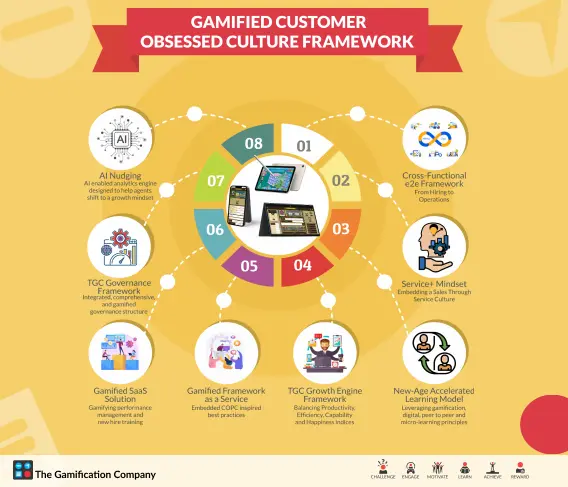
The Customer Obsessed Culture Framework is a behavioral, process, and governance model that aligns the entire service system to a single anchor: your Core Service Promise.

It is not a training program.
It is not a one-off CX initiative.

It is a structured method to:

  • define what customer-centric looks like in your context,
  • embed it into how work is performed, and
  • sustain it through governance, measurement, and capability building.

What it governs

This framework governs the practical layer where culture either becomes real, or stays aspirational.

It locks alignment across three domains:

Processes

Processes

the steps, workflows, and decision points that shape customer outcomes.

People practices

People practices

hiring signals, onboarding, coaching rhythms, recognition, escalation norms.
Systems

Systems

tools, templates, policies, and operational mechanics that either enable or block the promise.

Underneath those domains sits one non-negotiable: the Core Service Promise.
Not a slogan.
A functional statement of what customers can rely on, and what the organization must consistently deliver.

How it runs

The Customer Obsessed Culture Framework follows a disciplined journey. Each phase exists for a reason, and each prevents a predictable form of drift.

Phase One: Diagnostic, led by behavioral science and best practices
We begin with a diagnostic that surfaces what is happening in the system today, not what the organization believes is happening.

That diagnostic looks at:

  • observable behaviors and judgement patterns
  • friction points that trigger shortcuts
  • internal incentives that quietly override customer intent
  • variance across teams, locations, or leaders

This is the baseline that keeps the work grounded.

Phase Two: Define the Core Service Promise

Once reality is visible, the promise can be defined with credibility.

We shape a service promise that is:

  • clear enough to guide frontline decisions
  • specific enough to be operationalized
  • stable enough to be measured
  • realistic enough to be sustained

Then we translate it into behavioral expectations.
Not generic behaviors like “be empathetic”.

Operational behaviors like:

  • “clarify before committing”
  • “resolve with ownership, not referral”
  • “protect customer time”
  • “surface risk early”
  • “close the loop visibly”

Phase Three: Document processes, people practices, and systems

This is where culture stops being conceptual and becomes engineered.

We document and align:

  • critical workflows and handoffs that shape the customer journey
  • decision rules that reduce judgement variance
  • escalation paths that protect customer outcomes under pressure
  • coaching and feedback loops that reinforce the promise
  • system prompts and cues that make the right behavior easier than the wrong one

This is not documentation for its own sake.
It is documentation as alignment.

Phase Four: Implementation and measurement

Implementation is treated as a controlled rollout, not a motivational campaign.
We support:

  • piloting and progressive adoption
  • manager enablement so supervisors can coach to the promise
  • measurement design that tracks adherence and drift
  • feedback loops that allow the system to learn, not just comply

Measurement here is not about vanity metrics.
It is about whether the promise is becoming more reliable.

Phase Five: Training and certification
Training is used for what it is good at: building shared language, improving judgement, and raising baseline capability.

Certification exists for one reason.
To ensure the organization can trust execution.

The focus is on:

  • scenario practice that reflects real pressure
  • decision calibration so teams respond consistently
  • role-based expectations, not generic training content
  • reinforcement mechanisms that move learning into the day job

Phase Six: Governance for sustainability
Culture does not sustain itself.
It is sustained.

Governance ensures the framework stays aligned with evolving customer needs and business priorities, without losing integrity.

Governance includes:

  • review cadences that surface drift early
  • ownership clarity for the promise and its operational expression
  • change control for workflows and system cues
  • reinforcement requirements for leaders and managers

How it proves impact

A customer obsessed culture is visible.
It shows up in the way decisions are made and exceptions are handled.

You see it when:

  • customers experience fewer handoffs and fewer “next steps”
  • teams resolve more issues without escalation
  • managers coach behavior, not just outcomes
  • frontline judgement becomes consistent across locations
  • customer intent is protected even under time pressure

The goal is not perfection.
The goal is reliability.

What makes it defensible at scale

Most culture work breaks when it scales, because it depends on a few great leaders or a few high-performing teams.
The Customer Obsessed Culture Framework is designed to scale because it is built on controls, not charisma.

It is defensible because it:

  • converts values into governed behaviors
  • hardwires customer intent into process design
  • makes coaching and reinforcement a system rhythm
  • creates shared language for decision making
  • uses governance to prevent silent erosion

This is culture with operational backbone.

Where it fits best

This framework is most powerful in environments where customer outcomes depend on high volume, high pressure execution.

It fits especially well when you have:

  • service operations with many decision points
  • multi-site teams and leadership variance
  • front line roles where judgement matters more than scripts
  • growing organizations where culture is at risk of dilution
  • regulated or brand-sensitive environments where reliability is non-negotiable

Customer obsession is not what you announce. It is what your system allows.
The Customer Obsessed Culture Framework is the backbone behind how we build reliability into service behavior.

That is why the work has substance, and why it holds when the pressure shows up.

What Our Clients Have to Say

Our Clients on Customer Obsessed Culture